Ever wonder why one Arcadia street feels like a leafy estate lane while another feels like a canal-side connector with a totally different rhythm? If you are exploring Arcadia, buying here, or simply trying to understand what gives the neighborhood its identity, that question matters. Arcadia is not defined by one look or one rigid boundary. Its character comes from a mix of historic estate streets, canal edges, mature landscaping, and pocketed architectural layers that change from block to block. Let’s dive in.
Why Arcadia Feels So Distinct
Arcadia is best understood as a landscape-first neighborhood with overlapping boundaries, not a single uniform subdivision. The commonly recognized core runs north of the Arizona Canal and south of Camelback Road between 44th Street and Scottsdale Road, while other neighborhood definitions extend farther in several directions. In practical terms, that means Arcadia is better experienced as a collection of recognizable streets and sub-areas rather than one continuous streetscape.
What ties those areas together is the setting. Camelback Mountain acts as a visual anchor, while the Arizona Canal helps define the neighborhood’s form and feel. Together, those natural and infrastructure edges give Arcadia a sense of enclosure that many buyers notice right away.
Arcadia’s roots also explain why the neighborhood looks the way it does today. Early plats in the 1910s and 1920s were built around large lots, rural estate living, and small citrus orchards. Developers also created water infrastructure, including pumping plants and an underground irrigation system, which helped establish the mature landscaping and broad-lot character that still define the area.
Estate Streets Shape Arcadia’s Identity
If you want to understand classic Arcadia, start with the historic estate core. Camelback Road, Exeter Boulevard, and 56th Street are among the streets most closely tied to the neighborhood’s early identity. This is where Arcadia’s original estate-subdivision character reads most clearly.
These streets were shaped by large lot patterns and construction standards intended to create a cohesive, high-quality residential environment. Even when home styles vary, the blocks often feel visually consistent because early development required a degree of harmony between neighboring homes. That planning logic still shows up today in the spacing, setbacks, and overall rhythm of the streetscape.
The architecture in these areas adds another layer of distinction. Historic survey records identify early homes in styles such as Pueblo Revival and Spanish Colonial Revival on Camelback Road, Exeter Boulevard, 56th Street, and nearby streets. Those homes give parts of Arcadia a sense of age and permanence that can feel older and more textured than first-time visitors expect.
Arcadia Drive Creates a Strong Arrival
Some streets define Arcadia not because they hold the grandest homes, but because they create the strongest sense of arrival. Arcadia Drive is one of those places. Along the stretch between the Arizona Canal and Lafayette Boulevard, the public path and surrounding landscape create a shaded edge that feels notably residential and established.
The eucalyptus row on Arcadia Drive is especially important to that first impression. Local neighborhood descriptions identify it as a gateway landmark into Arcadia. It helps create the feeling that you are entering a greener, quieter environment that differs from the wider city grid nearby.
For buyers touring the neighborhood, this matters more than you might think. Streets like Arcadia Drive tell you that Arcadia’s appeal is not only about individual homes. It is also about how the neighborhood unfolds visually, with canopy, setbacks, and a softer sense of enclosure.
56th Street Shows Daily Arcadia Life
While some Arcadia streets feel ceremonial, 56th Street helps explain how the neighborhood works in everyday life. The City of Phoenix describes this corridor as a collector street in the Arcadia area, and current public planning work focuses on improving pedestrian and bicycle safety, adding shade trees, closing sidewalk and bike gaps, and strengthening links to the canal path, nearby schools, and transit.
That makes 56th Street more than a pass-through. It acts as a daily-use spine that connects homes, crossings, and neighborhood destinations. For someone evaluating Arcadia, this kind of corridor shows how beauty and function overlap in real life.
It also highlights something important about Arcadia’s identity. The neighborhood is not frozen in time. Its most familiar streets continue to evolve through planning and preservation, which helps maintain character while improving everyday usability.
Canal Edges Add a Greener Layer
The canal is a major part of Arcadia’s streetscape story. The Arizona Canal is the longest canal in SRP’s system and a main northside water conduit, but it also contributes to the neighborhood’s visual and recreational identity. Canal recreation has been open since 1964, and more than 80 miles of trails have been developed by SRP and city partners.
In Arcadia, that canal edge does real work in shaping atmosphere. It creates greener seams, buffered paths, and a stronger sense of separation from surrounding traffic corridors. When you move near the canal, the neighborhood often feels more shaded, more planted, and more connected to its irrigation history.
Arizona Falls, located on the Arizona Canal between 56th and 58th streets, adds another local landmark to that story. It is both a neighborhood attraction and a hydroelectric plant, which makes it one of the more distinctive places where infrastructure and local identity meet.
On the Arcadia Osborn side, Old Cross Cut Canal Park adds a similar effect along 48th Street from McDowell Road to Indian School Road. That park corridor gives the street a greener and more park-like edge than a standard arterial, which reinforces the idea that Arcadia’s character often comes from landscape as much as architecture.
Trees, Lawns, and Irrigation Matter Here
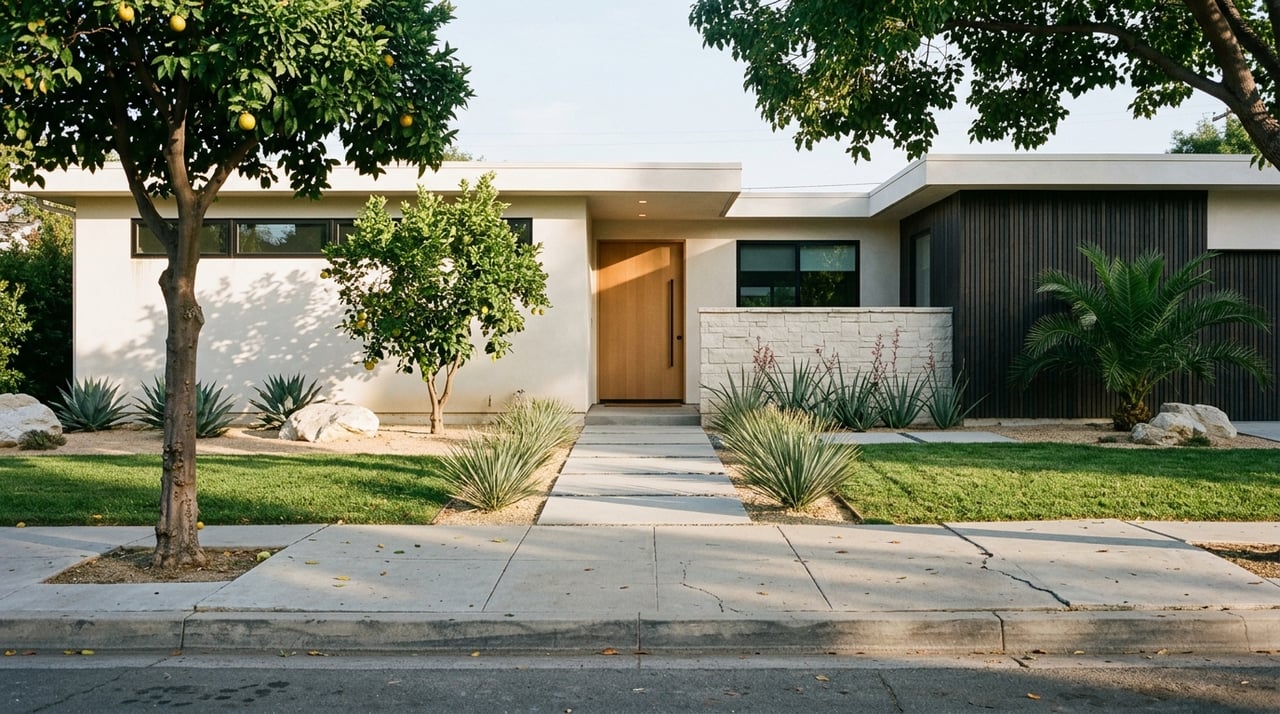
Arcadia’s most memorable feature may be its cultivated landscape. Neighborhood descriptions emphasize generous setbacks, broad lawns, historic citrus trees, and a residential, non-commercial character. Those traits are not accidental. They are a direct result of the area’s original development pattern as a rural estate and orchard district.
This is why Arcadia often feels different from other established Phoenix neighborhoods. The identity comes from the interaction of citrus legacy, eucalyptus rows, palms, irrigated lawns, and canal-adjacent tree cover. The streetscape is not just a backdrop for homes. It is part of the neighborhood’s value and experience.
That landscape also changes the way streets feel at ground level. Shade, curbside trees, and wide front yards create a softer and quieter impression. The Arizona Canal and Camelback Mountain further reinforce that effect by helping buffer parts of the neighborhood from heavier through-traffic.
Arcadia’s Home Styles Change by Block
One of the biggest misconceptions about Arcadia is that it has one dominant home style. In reality, its architectural layers are uneven by block. Some streets carry more visible prewar character, while others are defined by mid-century ranch homes or later infill that still sits within the broader landscape framework.
The prewar layer is concentrated in the historic estate streets. Historic survey records identify Pueblo Revival and Spanish Colonial Revival homes in several parts of the neighborhood, including Camelback Road, Exeter Boulevard, 56th Street, and Calle de Media. These homes help give certain blocks a more formal and historically grounded feel.
The mid-century layer is also important, but it appears in pockets rather than across the entire area. Arcadia Osborn is known for mid-century ranch homes, flood-irrigated lawns, and historic citrus groves, and other sections of Camelback East contain housing stock largely built from 1950 to 1970. In the Mountgrove area, on the former Sphinx Date Ranch between 46th Place and 47th Place, most homes were built in 1954 and date palms were intentionally preserved.
That mix is part of Arcadia’s appeal. Instead of a single visual formula, you get a layered neighborhood where estate streets, ranch pockets, and canal edges all contribute to a broader sense of place.
Preservation Helps Hold the Look Together
Arcadia’s character is supported by more than history alone. Preservation policy and planning tools also help shape what you experience on the street today. Phoenix’s historic-property system reviews exterior alterations and demolition requests for designated properties, and the Camelback East village framework includes Arcadia-specific planning tools and overlays.
For homeowners and buyers, this matters because neighborhood character is not just a matter of luck. In parts of Arcadia, there is an active framework that helps preserve important features and guide change. That can be a meaningful part of long-term value, especially in a neighborhood where setting and architectural continuity carry real weight.
What Buyers Should Notice on a Tour
If you are touring Arcadia, focus on more than the home itself. Pay attention to how the street feels when you arrive, how the lots are spaced, how much canopy is present, and whether the block reads more like an estate street, a canal edge, or a mid-century pocket. In Arcadia, those details often tell you as much as square footage or finishes.
It also helps to notice how each corridor expresses the same core themes in a different way. One block may feel formal and historic. Another may feel greener and more casual. A third may reflect a stronger mid-century pattern. Those variations are not inconsistencies. They are part of what makes Arcadia recognizable and enduring.
If you are considering buying or selling in Arcadia, understanding these micro-differences can shape both lifestyle fit and pricing strategy. Streetscape, setting, and neighborhood texture are a meaningful part of how this market is experienced.
Arcadia stands out because it still reads as an irrigated desert garden with history layered into the street grid. Its most iconic streets do not all tell the same story, but together they create one of the most visually distinct residential environments in the Phoenix area. If you want guidance on how specific blocks, corridors, and homes fit into the broader Arcadia picture, Clayton Wolfe offers a polished, highly personalized approach grounded in local market knowledge.
FAQs
What makes Arcadia streetscapes different from other Phoenix neighborhoods?
- Arcadia’s streetscapes are shaped by large historic lots, mature trees, irrigation infrastructure, canal edges, and Camelback Mountain as a visual anchor, which creates a shaded and layered residential feel.
Which streets are most iconic in Arcadia, Arizona?
- Camelback Road, Exeter Boulevard, 56th Street, and Arcadia Drive are among the most recognizable streets because they reflect Arcadia’s estate character, daily connectivity, and gateway landscaping.
Why does Arcadia have so many mature trees and broad lawns?
- Arcadia developed from early rural estate and citrus-orchard plats, supported by a dedicated water system and underground irrigation infrastructure that helped establish its long-lasting landscape character.
Does Arcadia have one consistent architectural style?
- No. Arcadia includes prewar estate homes, Pueblo Revival and Spanish Colonial Revival examples, and pocketed mid-century ranch areas, so the architectural character changes by block.
How does the Arizona Canal affect Arcadia neighborhood character?
- The canal adds green edges, trails, visual separation, and a strong connection to the neighborhood’s irrigation history, all of which contribute to Arcadia’s distinctive streetscape.
Why is 56th Street important in Arcadia?
- 56th Street functions as an everyday connector that links homes, crossings, the canal path, and nearby destinations, making it one of the clearest examples of how Arcadia works at street level.